

Introduction
The Latin phrase Sic semper tyrannis—translated as “thus always to tyrants” is one of the most enduring political expressions in Western history. At its core, the phrase functions as a warning: tyranny is never permanent, and those who rule through oppression will ultimately face downfall. Over centuries, the phrase has moved from classical antiquity to revolutionary symbolism, American state identity, and modern political controversy.
Sic Semper Tyrannis — Key Attributes
| Attribute | Details |
|---|---|
| Phrase | Sic semper tyrannis |
| Language | Latin |
| Literal Meaning | “Thus always to tyrants” |
| Core Idea | Tyranny inevitably leads to downfall |
| Earliest Attribution | Roman Republic (traditionally linked to Brutus) |
| U.S. State Association | Virginia |
| Adopted as Motto | 1776 |
| Modern Usage | Political rhetoric, historical references |
| Controversial Associations | Yes (due to misuse in violent contexts) |
Meaning and Interpretation
Sic semper tyrannis is not a call to violence in its original philosophical sense. Rather, it expresses a moral principle rooted in republican thought: absolute power invites resistance, and unjust rulers sow the seeds of their own destruction.
The phrase has often been invoked to symbolize:
- Resistance to authoritarianism
- Defense of liberty and self-governance
- The cyclical nature of political power
Roman Origins and Classical Context
The phrase is traditionally—though not definitively—attributed to Marcus Junius Brutus, one of the senators involved in the assassination of Julius Caesar in 44 BCE. Classical historians such as Suetonius and Plutarch do not record Brutus speaking these words, leading scholars to conclude the association is likely symbolic rather than literal.
A longer, less commonly cited version exists:
Sic semper evello mortem tyrannis
“Thus always I bring death to tyrants.”
This extended form reinforces the phrase’s philosophical framing within Roman anti-monarchical ideology.
Virginia’s State Motto
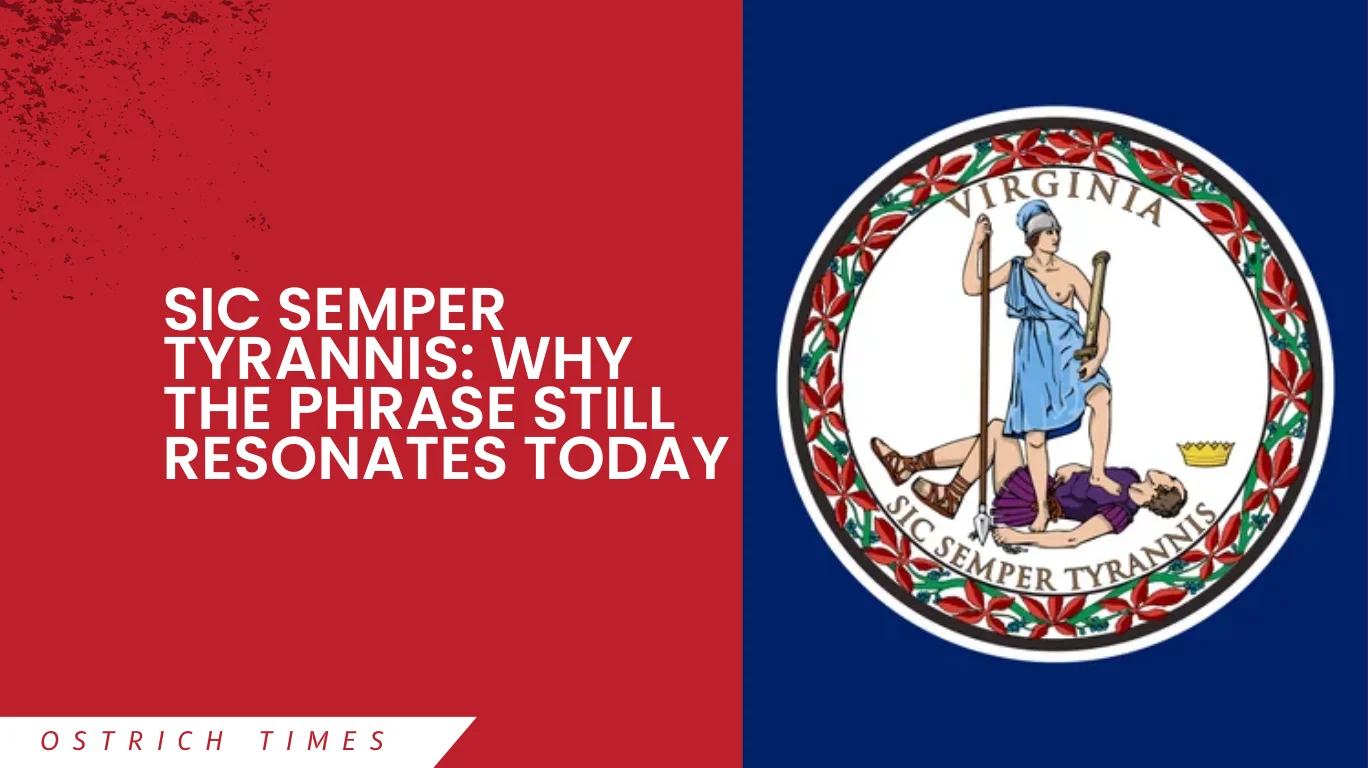
In 1776, Virginia adopted Sic semper tyrannis as its official state motto, embedding it into the Virginia State Seal.
Symbolism on the Seal
- Virtus (Virtue) stands victorious
- A fallen tyrant lies beneath her foot
- The crown has fallen, symbolizing rejected monarchy
The imagery reflects Revolutionary-era ideals and Virginia’s rejection of British royal authority.
The Lincoln Assassination and Historical Infamy
The phrase gained global notoriety in American history through its association with the assassination of President Abraham Lincoln in 1865. According to several eyewitness accounts, John Wilkes Booth shouted “Sic semper tyrannis!” as he fled Ford’s Theatre.
This moment profoundly altered how the phrase was perceived, permanently linking it—fairly or not—with political violence in the public imagination.
Modern and Extremist Associations
In the late 20th century, the phrase reappeared in disturbing contexts, most notably:
- Timothy McVeigh, the Oklahoma City bomber, reportedly wore a T-shirt bearing the phrase at the time of his arrest.
Because of such misuse, Sic semper tyrannis today occupies a complex cultural space—simultaneously a historical motto and a phrase occasionally appropriated by extremist individuals. Importantly, the phrase itself is not inherently extremist, but its interpretation depends heavily on context and intent.
Cultural and Contemporary Usage
Despite controversy, the phrase continues to appear in:
- Academic discussions of republicanism
- Historical literature and art
- Political philosophy debates
- Commercial items (flags, clothing, memorabilia)
Its survival underscores how language can outlive—and outgrow—its original moment.
Frequently Asked Questions (FAQs)
What does Sic semper tyrannis mean?
It means “thus always to tyrants,” expressing the belief that tyrannical rule inevitably ends in downfall.
Is Sic semper tyrannis a threat?
Historically, it is a philosophical statement, not a direct threat. However, it has been misused in violent contexts.
Who first said Sic semper tyrannis?
The phrase is traditionally attributed to Brutus, but there is no historical proof he actually spoke it.
Why is it Virginia’s state motto?
Virginia adopted the phrase in 1776 to symbolize resistance to monarchy and commitment to republican government.
Is the phrase associated with extremism?
The phrase itself is not extremist, but some individuals have used it in extremist acts, which has complicated its modern perception.
Conclusion
Sic semper tyrannis is a phrase shaped as much by history as by interpretation. Born from classical ideals of liberty, elevated during the American Revolution, and later tainted by acts of violence, it stands as a reminder that language carries power—and responsibility. Whether viewed as a warning, a motto, or a cautionary tale, the phrase continues to spark debate about authority, resistance, and the fine line between principle and misuse.





















Leave a comment